SEO audit in Malaysia: what a proper one covers
An SEO audit is a review of a website that finds what is stopping it from being found in search, and puts the problems in order of importance. A proper one covers five areas: technical health, content, links, competitors and, now, visibility in AI answers.
If you search for an SEO audit in Malaysia, almost every result is an agency offering one, often free and often in sixty seconds. Some of those are useful. Many are a scan with a score on top. This is a guide to telling the difference, written by someone who has worked in SEO for ten years, most of it inside one company.
What a 60-second report can and cannot tell you
An automated report checks things a machine can count: missing titles, slow pages, broken links, missing image descriptions. That is worth knowing, and you can get it yourself from free tools.
What it cannot tell you is which of its forty warnings matter. A missing description on a page nobody visits is not a problem. One wrong line that hides your product pages from Google is, and a scan will often list both with the same weight. An audit is the judgement about which is which.
What a proper SEO audit covers
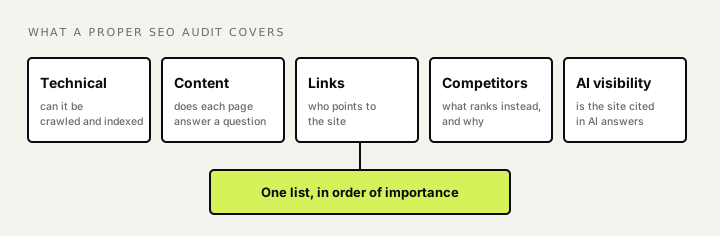
1. Technical health. Can search engines reach your pages, are they keeping them, and do they understand them? This is where the most damaging problems hide, because they are invisible from the outside.
2. Content. Does each important page answer a real question, clearly and early? Are several pages competing for the same search? Are there many thin pages weakening the rest?
3. Links. Which sites link to you, are they relevant, and how do your own pages link to each other?
4. Competitors. For the searches you care about, who ranks instead of you, and what do their pages have that yours do not?
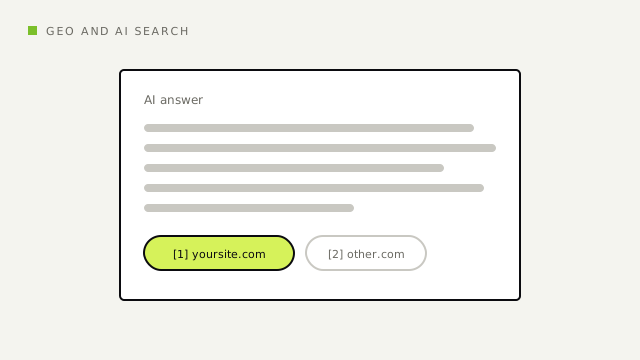
5. AI visibility. When someone asks ChatGPT or Google’s AI Mode a question in your field, are you named? This is new, and an audit that ignores it is already out of date.
The result should be one list in order of importance, with a reason beside each item, not a hundred-page document.
What is different about auditing a Malaysian site
The method is the same anywhere. A few things come up more often here.
- More than one language. Customers may search in English, Malay or Chinese, sometimes mixing them in one search. An audit should look at which language your customers actually use for each topic, and whether your pages match it. A page that mixes languages halfway through tends to serve none of them well.
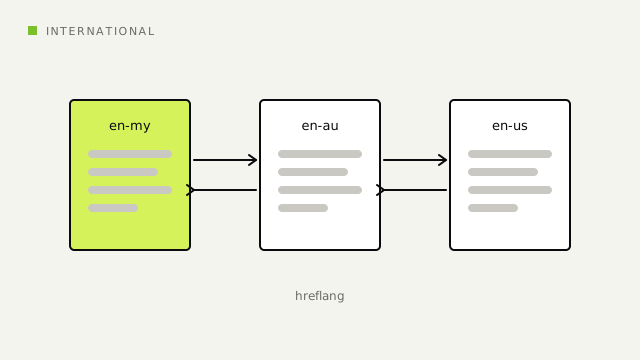
- Local and international versions. Many Malaysian businesses have a .com.my site and a .com site, or a regional site covering Singapore as well. Without the right signals, the wrong one appears. I cover this in my international SEO checklist.
- Marketplaces in the results. For product searches, large marketplaces often fill the first page. An audit should say plainly which searches a store can realistically win on its own site, and which it cannot.
- Speed on mobile. A great deal of searching here happens on phones. An audit should test pages on a mid-range phone and an ordinary connection, not on an office computer.
[To add, Franklin: one or two things you see again and again on Malaysian sites, in your own words.]
Questions to ask before you accept an audit
- Who will look at my site? A named person, or a tool?
- What tools do you use, and what will you check by hand?
- Will the findings be in order of importance, with reasons?
- Will you tell me what not to bother fixing? This is a good test. Anyone can produce a long list.
- Does it cover AI search as well as Google?
- What do you need from me? A real audit usually needs access to Search Console. If nobody asks for it, they are only looking from the outside.
- What happens after? Is the audit a document, or the opening of a sales conversation? Either is fine, as long as you know which.
What you can check yourself first
Before asking anyone, you can learn a lot in an hour:
- Open Google Search Console and look at the page indexing report. How many pages are indexed, and how many are not?
- Search Google for your own business name, then for your three most important products or services. What appears?
- Load your home page on your phone, on mobile data. Count the seconds.
- Ask an AI assistant the question your best customer would ask. Are you mentioned?
If any of those surprises you, you already know where an audit should begin. The checks behind them are in my technical SEO checklist and my on-page SEO checklist.
My own approach
I offer a free audit through this site. I review the site myself against the goal you give me, and reply by email with the things I would fix first. There is no automated report. How I work through an audit is set out on the SEO audits page.
[To add, Franklin: optional closing line in your voice.]
How I approach this: SEO Audits

I've worked in SEO since 2016, starting on the founding team of DoctorOnCall. I write here about SEO and how it carries over into AI search.