ChatGPT Business Hub: how to claim it and read the numbers
Until this month, anyone working on AI visibility had the same problem. We could ask ChatGPT a question and see whether a brand appeared. We could not see how often it happened across everyone’s conversations. Every figure was an estimate from an outside tool.
On 10 November 2026, OpenAI opened a beta called Business Hub. A business can claim its profile and, once verified, see figures from OpenAI itself: how often ChatGPT mentioned it, how many clicks went to its website, and which topics it was found through. The figures cover the past 28 days.
It is the nearest thing yet to a Search Console for an AI system, and it bears directly on how I approach GEO. It is also easy to misread, so here is how I would approach it.
How to claim your business in ChatGPT
OpenAI’s help page gives the steps:
- Sign in to ChatGPT and open Business Hub from the sidebar.
- Search for your business by name.
- Select the listing that matches and confirm the ChatGPT account that will manage it.
- Complete identity verification.
- Once the claim is approved, open your business in Business Hub and select Insights.
What Business Hub shows
According to the published reports, a verified business sees three things:
- Mentions: how often ChatGPT referred to the business.
- Website clicks: how often someone clicked through to the site.
- Discovery topics: the subjects of the conversations where the business came up.
Claiming is open to eligible businesses wherever ChatGPT is available, and needs identity verification.
[To add, Franklin: if you claim a site, describe the process here in two or three sentences: how long verification took and what the screen shows.]
The details that change how you read it
Four points from the early reports matter more than the headline figures.
1. For an online business, a mention means your website was referenced. Your brand name appearing on its own does not count. So the mention figure is closer to “times cited” than “times talked about”. A brand that is often named without a link will look smaller here than it is.
2. A click is not a confirmed visit. The figure records the click. Whether the page loaded and your analytics counted it is a separate matter, so the two numbers will not match.
3. A blank figure does not always mean zero. Like most privacy-minded reporting, small numbers may be withheld.
4. Claiming your business does not make ChatGPT mention you more. OpenAI says so directly. It is a reporting tool, not a ranking lever.
Does claiming help you get cited by ChatGPT?
No. Claiming shows you the figures. Getting cited by ChatGPT still depends on whether your pages can be fetched, whether they answer the question plainly, and whether other sources mention you.
The gap between mentions and clicks
One early example is worth looking at. Search Engine Journal’s director of technology shared the figures for their own site: about 353,000 mentions and about 2,700 website clicks in 28 days.
That is fewer than one click for every hundred mentions.
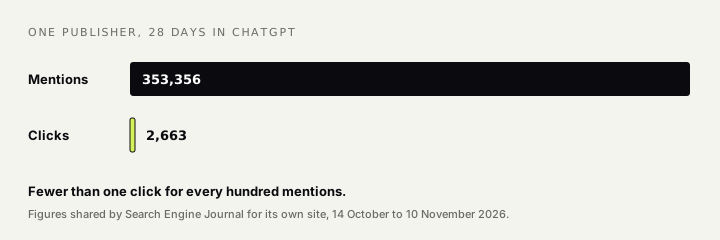
It would be easy to read that as bad news. I read it differently. It is the first hard evidence of something many of us suspected: in AI answers, being cited and being visited are two separate things, and the first is far more common than the second. People read the answer, see the source, and move on.
That does not make the mention worthless. A person who sees a name in an answer may search for it later, or recognise it when it matters. It does mean that judging AI visibility by traffic alone will undercount it badly.
One example from one publisher is not a rule. A shop or a booking service may see a very different ratio. That is exactly why each business should look at its own figures.
What I would do with it
- Claim your business, if you are eligible. It costs nothing but a verification step, and the data starts from when you can see it.
- Record a baseline. Write down mentions, clicks and the top discovery topics for the first 28 days. The trend will matter more than any single figure.
- Read the discovery topics closely. They show what ChatGPT thinks you are a source for. If the topics are not the ones you want to be known for, that tells you what to write about.
- Compare with your own analytics. Look at visits from ChatGPT in your analytics beside the click figure. Expect a gap, and note how big it is.
- Watch brand searches too. If mentions rise and searches for your name rise with them, the mentions are doing something that clicks do not show.
What I would not do
I would not turn the mention count into a target and chase it. A number this new, with rules still in beta, is a poor thing to tie a bonus or a budget to.
I would also not treat it as the whole picture. It covers one AI system. Google’s AI Overviews and AI Mode, Perplexity and others are not in it.
And I would not forget where these mentions come from. ChatGPT cites pages it can fetch, read and trust. A site that cannot be crawled, or that hides its content behind scripts, will have little to report no matter how the dashboard is read. The foundation is still SEO, as I set out in my technical SEO checklist and in GEO vs SEO in 2026.
[To add, Franklin: your own closing view, for example whether you think this will push other AI companies to share the same data.]