GEO vs SEO in 2026: the difference, and why you need both
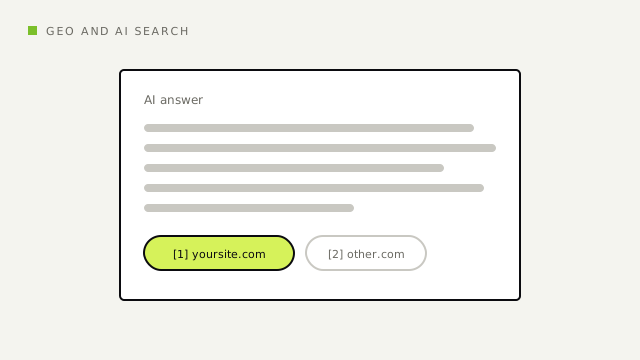
SEO gets a page ranked in search results. GEO, generative engine optimisation, gets a page or a brand cited inside AI answers such as ChatGPT and Google’s AI Mode. The two are not rivals: GEO is built on SEO.
That is the short answer to GEO vs SEO. The longer one starts with a puzzle.
Two things are true about search at the end of 2026, and they sound like they contradict each other. People are searching more than they have in years. And websites are getting fewer visits.
Both are true at once, and understanding why is the clearest way I know to explain where SEO and GEO stand.
People are searching more
On Alphabet’s third-quarter earnings call, Sundar Pichai said Google’s query growth was the highest it has been in five years, and credited AI for it. Google also said that questions asked in AI Mode run about three times the length of an ordinary search, and that most of them are new searches, not old ones moved across.
That matches what I see. People now ask a search engine things they would once have asked a colleague: long, specific questions with a lot of context.
Websites are getting fewer visits
Data from Similarweb, published by SparkToro this month, shows visits to the world’s top million websites in the third quarter of 2026 were about 12% below their early 2022 peak. Per internet user, the fall is steeper, close to 29%, because the number of people online grew over the same period.
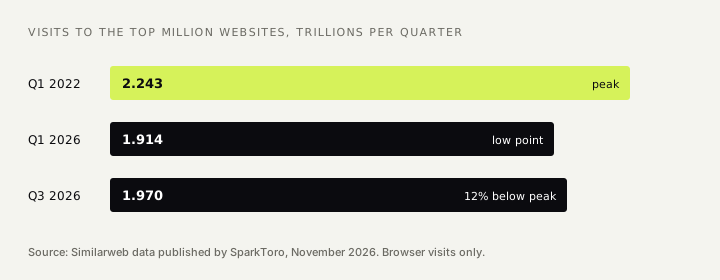
Some caution is due. The data counts browser visits, not app use, and it is worldwide, so it hides differences between regions. Rand Fishkin, who published it, lists several possible causes, and AI tools are only one of them. Still, the direction is hard to argue with: more questions asked, fewer clicks out.
The reason is simple. More questions are being answered on the results page or inside the AI answer, without a visit to anyone’s site.
What is GEO in SEO?
GEO, generative engine optimisation, is the work of getting a brand or a page mentioned and cited inside AI answers: Google’s AI Overviews and AI Mode, ChatGPT, Perplexity and the rest.
SEO asks, “Does my page rank when someone searches?” GEO asks, “When an AI system answers this question, does it use my page, and does it name me?”
GEO vs SEO at a glance
| SEO | GEO | |
|---|---|---|
| Goal | Rank in search results | Be cited or named in AI answers |
| What is judged | The page | The passage, and the brand |
| Result | A click to your site | A mention, sometimes a click |
| Measured by | Rankings, clicks, traffic | Mentions, citations, brand searches |
| Depends on | Crawling, indexing, content, links | All of that, plus what others say about you |
Where does AEO fit?
AEO, answer engine optimisation, is an older name for writing content that can be lifted as a direct answer, in a featured snippet or by a voice assistant. In practice it overlaps almost entirely with GEO, and I treat the two as one job.
Why I do not treat them as rivals
The phrase “SEO vs GEO” suggests a choice. I do not think there is one, because of how these systems work.
An AI answer with sources is built by searching. The system breaks the question into several smaller searches, fetches the pages that come back, reads them, and writes an answer from the parts it trusts. Google calls this query fan-out, and its newest default model for AI Mode, switched on this month, is described as doing more of it and linking to a wider range of pages.
Follow that through. To be cited, a page first has to be crawlable, indexed, understood and trusted enough to be fetched. Those are SEO jobs. Google’s John Mueller put it directly in a recent interview: AI systems build on SEO, and the sites that last are the ones with a serious, stable foundation, not the ones chasing a tactic that works until the system changes.
That is why I say SEO is the backbone of GEO. A site with weak SEO has nothing for GEO to stand on. The foundation itself is covered in my technical SEO checklist.
What is different about GEO
It is the same foundation, with different demands on top.
- The unit is the passage, not the page. AI systems quote sentences and short sections. Each section needs to make sense on its own.
- Being mentioned matters, even without a click. Someone may read your name in an answer and search for you a week later. That visit will not be labelled as coming from AI.
- What others say about you counts for more. AI systems lean on reviews, forums, news and comparison pages to decide which brands to name. Your own site is only one of the sources.
- Measurement is young. Until recently there was almost no first-hand data. That is starting to change: this month OpenAI opened a beta that shows businesses how often ChatGPT mentions them and sends clicks. It is early, and it is a start. I look at it in how to read ChatGPT’s mention and click figures.
What I would do now
- Fix the foundation first. If pages are not being crawled and indexed properly, nothing else here will work. My GEO page sets out how I approach the rest.
- Write to be quoted. Answer the question early, in plain sentences, and then explain.
- Add something first-hand. Original data, a real example, a clear opinion. An AI system has no reason to cite the fifth copy of the same summary.
- Keep a fixed list of questions your customers ask, and check them on a schedule across the main AI systems. Note whether you are named, cited or missing.
- Stop judging everything by clicks alone. Watch searches for your brand name, enquiries and sales alongside traffic.
What I would not do
I would not pay for a “GEO package” that promises placement in AI answers. Nobody can promise that. I would also be slow to rebuild a site around this month’s trick. The tactics that work for a few months tend to be the ones that get switched off.
[To add, Franklin: your own view in two or three sentences would make this the strongest part of the article. For example, what you tell teams who ask whether they should move budget from SEO to GEO.]
Is GEO replacing SEO?
No. SEO did not end, and GEO is not a replacement. People are asking more questions than ever. The work is making sure that when the answer is written, your pages are among the ones it is written from.