On-page SEO checklist: one page, one question, one answer
On-page SEO is everything you change on a page itself so that people and search engines understand it: the words, the title, the headings, the links and the images. This on-page SEO checklist puts those in order of weight.
It is often taught as a list of places to put a keyword: the title, the first paragraph, a heading, the image description. Follow the list and the page is “optimised”.
That list is not wrong. It is just the smallest part of the job. A page can tick every box and still fail, because the page itself is not a good answer to anything. I find it more useful to hold one rule and derive the rest from it:
One page, one question, one clear answer.
Start with the question
Every search is a question, even when it is two words long. Someone typing “seo audit malaysia” wants to know who does audits here and what one involves. Someone typing “what is a canonical tag” wants a definition and an example.
Before I change a word on a page, I search the term myself and read what already ranks. That shows what kind of answer people reward: a guide, a product page, a comparison, a tool. If the top results are all step-by-step guides and my page is a sales page, no amount of editing will fix the mismatch. The page is answering a different question.
Then I check whether my own site is competing with itself. Two pages aimed at the same question split the attention between them, and usually neither does well. Merge them, or give each a clearly different question.
Answer early
The best change I know for most pages is also the simplest: put the answer near the top.
A page that opens with three paragraphs of background before it gets to the point loses the impatient reader. It also loses the machine. Search engines pull short passages for featured snippets, and AI systems quote the sentences that answer the question most directly. Both favour a page that states the answer plainly and then explains it.
So: answer in the first two or three sentences. Then use the rest of the page for the detail, the examples and the exceptions.
The on-page SEO factors, in order of weight
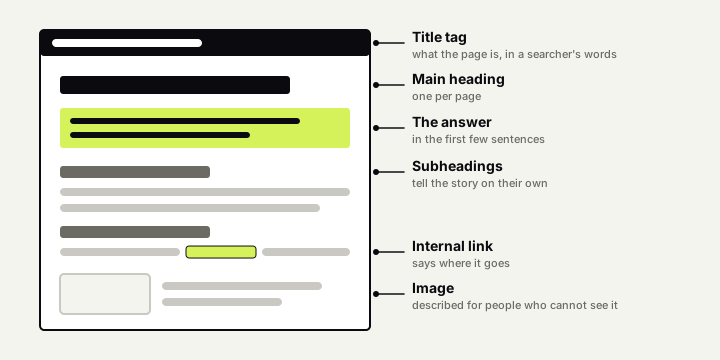
- Title tag. The single most important line. Say what the page is, in the words a searcher would use, with the important words first. It is also your advert in the search results, so it has to be worth clicking.
- The main heading. One per page, close in meaning to the title. It confirms to the reader that they are in the right place.
- Subheadings. Write them so that someone reading only the subheadings would understand the page. Phrasing some as the questions people ask works well, as long as the answer follows straight away.
- The body. Plain sentences, specific nouns, real examples. Use the main term naturally and the related terms it brings with it. If you have to force a keyword in, the page is about the wrong thing.
- Internal links. Link to the pages a reader would want next, with link text that says where it goes. “Our guide to canonical tags” tells a search engine something. “Click here” tells it nothing.
- Images. Describe what the image shows, for people who cannot see it. Compress it so the page stays fast.
- Meta description. It does not affect ranking. It affects whether people click, so write it for them.
- The address. Short, readable, lower case, words separated by hyphens.
Add what only you can add
The hardest part of on-page work is also the part no checklist covers. If a page only repeats what the ten pages above it already say, there is no reason for it to rank, and no reason for an AI system to cite it over them.
What sets a page apart is usually something first-hand: a figure from your own data, a mistake you made and what it cost, a screenshot of the real thing, a clear opinion with reasons. One paragraph of that is worth more than five paragraphs of careful summary.
[To add, Franklin: an example from your own work would land well here. One suggestion: how the health Q&A pages at DoctorOnCall were structured so that each page answered one patient question, if that is accurate.]
Writing for AI answers is the same job, done strictly
When I check a page for AI search, I am applying the same rule more strictly. AI systems break a question into smaller questions, fetch pages for each, and lift the passages that answer them. A page does well when:
- each section makes sense on its own, without needing the paragraph before it;
- names are used consistently, so “the product” is not “the platform” two lines later;
- claims are specific and can be checked;
- the author and the date are clear.
None of this is new. It is what clear writing has always been. For the wider picture, see GEO vs SEO in 2026.
On-page SEO vs off-page SEO
On-page SEO is what you control on the page. Off-page SEO is what happens elsewhere: links from other sites, mentions, reviews. On-page work comes first, because there is little point earning attention for a page that does not answer the question well.
The on-page SEO checklist: a five-minute version
- Can you say in one sentence what question this page answers?
- Is that answer in the first three sentences?
- Does the title say the same thing in a searcher’s words?
- Do the subheadings tell the story on their own?
- Is there one thing here that the other results do not have?
If the answer to any of these is no, start there. The keyword placement can wait.
On-page work only pays off once a page can be crawled and indexed, which is the subject of my technical SEO checklist. My fuller approach is on the on-page optimisation page.
How I approach this: Keyword and Content Strategy

I've worked in SEO since 2016, starting on the founding team of DoctorOnCall. I write here about SEO and how it carries over into AI search.