International SEO checklist: structure, hreflang, language
International SEO is the work of making sure people in each country, and each language, land on the version of your site meant for them. This checklist covers it in the order the decisions have to be made: markets first, then address structure, then hreflang, then the content itself.
The order matters. Hreflang cannot rescue a poor structure, and no structure helps if you have not decided which markets you are serving.
1. Decide your markets, by country and by language
Country and language are two separate things. Malaysia has English, Malay and Chinese speakers. Australia and the United States share a language and little else in prices, spelling or law.
Write down each combination you will serve, for example “English for Malaysia” and “English for Australia”. Each one is a version of the site. If you cannot keep a version up to date, do not launch it. A half-translated version does more harm than none.
2. Choose one address structure
There are three ways to split a site by country.
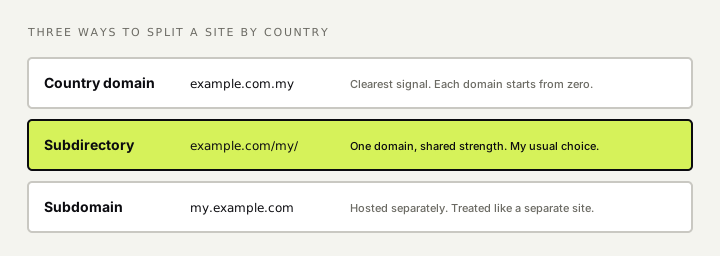
- Country domains such as example.com.my send the clearest signal, and people trust them. Each one is a separate site that has to earn its own standing.
- Subdirectories such as example.com/my/ keep everything on one domain, so every version benefits from the same links. They are the simplest to run.
- Subdomains such as my.example.com are easy to host separately, and tend to be treated more like separate sites.
For most businesses I would choose subdirectories. Whatever you choose, use it everywhere. Mixed structures are where things go wrong.
Do not use address parameters such as ?country=my for versions. And do not send visitors to a version automatically based on their location. Crawlers mostly visit from one country and may never see the others. Suggest the right version with a banner, and let the visitor choose.
3. Hreflang, done precisely
Hreflang is a tag that tells search engines which version of a page is meant for which language and country. It does not improve rankings. It makes sure the right version is the one shown.
It fails silently when it is slightly wrong, so the details matter:
- Every version lists every version, including itself. If the Malaysian page points to the Australian page, the Australian page must point back. Tags without a return tag are ignored.
- Use the right codes. Language first, then country: en-my, en-au, en-gb. The United Kingdom is “gb”, not “uk”. A country code alone, without a language, is not valid.
- Add an x-default. This names the page to show when no version matches the visitor, usually a general English page or a country chooser.
- Each version is its own canonical. If the Australian page names the US page as canonical, you have told search engines to ignore the Australian one, and its hreflang with it.
- Only point to working pages. No redirects, no “not found” pages, nothing set to noindex.
You can place hreflang in the page, in the sitemap or in the HTTP header. On a large site the sitemap is easiest to keep correct. Pick one method and use only that.
[To add, Franklin: one or two sentences on an hreflang problem you have found and fixed across the Australia, Malaysia or New Zealand sites.]
4. Same language, different countries
This is the case I work with most, and the one most often done lazily. Three English versions with identical text look like duplicates, and search engines may fold them together and show whichever they prefer.
Hreflang helps here, and real differences help more:
- prices in the local currency;
- local spelling and vocabulary;
- local examples, regulations, delivery and contact details;
- titles and descriptions written for that market.
5. Localise, do not only translate
A translated keyword is often not the word people use. Research each market’s searches separately, in its own language. Translated pages should be checked by someone who speaks the language natively, and that includes titles, descriptions, image descriptions and structured data, which are easy to forget.
6. Check each version on its own
Set up reporting per country version, not for the site as a whole. In Search Console, filter by country and check that the right version appears in each. Crawl each version and confirm it links within itself, with a visible way to switch.
AI answers and international sites
AI systems choose sources per language and often per market. A page that states plainly which country it applies to, with local currency, local names and a clear date, is easier for them to match to the right question. Mixed-language pages are harder for them to use, as they are for people.
The international SEO checklist
- Every country and language combination is written down.
- No version is launched that cannot be maintained.
- One address structure, used everywhere.
- No automatic redirects by location.
- Hreflang lists every version, including itself, with return tags.
- Codes are valid: language, then country.
- An x-default is set.
- Each version is its own canonical.
- Same-language versions differ in currency, spelling and details.
- Keywords are researched per market, not translated.
- Reporting is split by country.
[To add, Franklin: optional closing line in your voice.]
Everything here sits on the basics in my technical SEO checklist. For stores selling into several countries, see ecommerce SEO best practices. My wider approach is on the international SEO page.
How I approach this: International and Multi-Country SEO

I've worked in SEO since 2016, starting on the founding team of DoctorOnCall. I write here about SEO and how it carries over into AI search.